
Macron defends EU artificial intelligence rules in India
Stockholm, February 19 (Hibya) - According to The Guardian, speaking at the Artificial Intelligence Impact Summit in Delhi, French President Emmanuel Macron called for tougher measures following global outrage over the use of Elon Musk’s Grok chatbot to generate tens of thousands of sexualized images of children, and amid growing concerns about the concentration of AI power in the hands of a few companies.
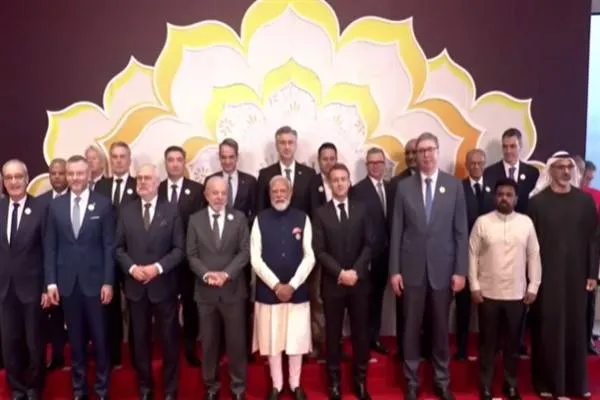
Emmanuel Macron pushed back against U.S. criticism of Europe’s efforts to regulate artificial intelligence and pledged that during France’s G7 presidency, the country would protect children from “digital exploitation.”
These remarks were echoed by UN Secretary-General António Guterres, who told delegates—including several U.S. tech billionaires—that “no child should serve as a test subject for unregulated AI.”
Guterres said, “The future of artificial intelligence cannot be determined by a few countries or left to the whim of a few billionaires. AI must belong to everyone.”
Bill Gates had been scheduled to speak but withdrew at the last minute due to renewed scrutiny over his past ties to convicted child sex offender Jeffrey Epstein.
On Wednesday, White House senior AI adviser Sriram Krishnan reiterated the Trump administration’s criticism of AI regulations, specifically targeting the EU’s Artificial Intelligence Act.
Macron told delegates he would continue to “speak out” against laws “that are not conducive to an entrepreneur seeking to develop innovative technology.”
However, at the intergovernmental summit, Macron stated: “Contrary to what some of our misinformed friends say, Europe is not blindly focused on regulation. Europe is a space for innovation and investment, but also a safe space—and safe spaces win in the long term.”
A study published this month by UNICEF and Interpol across 11 countries revealed that at least 1.2 million children’s images were turned into sexualized deepfakes over the past year. In some countries, one in every 25 children—equivalent to one child per classroom—was affected.
Among the technology executives in attendance was OpenAI CEO Sam Altman, who is facing a legal challenge from the family of 16-year-old Adam Raine, who died by suicide after discussing suicide with ChatGPT.
Anthropic co-CEO Dario Amodei said he was “concerned about the autonomous behavior of AI models, their potential misuse by individuals and governments, and the potential for economic displacement.”
Indian Prime Minister Narendra Modi compared the emergence of AI to the discovery of fire, describing it as “a profound transformation in human history,” and said that “AI must be child-safe and family-oriented.”
India aims to position itself as the world’s third AI power after the United States and China; Google announced this week that it would invest $15 billion in data centers and undersea cables linking India to the U.S. and other countries.
Modi said, “There must be a defined level of authenticity for content in the digital world... people must know what is real and what is generated by AI.”
These interventions come amid growing public concern about the societal risks of AI, at a time when the most advanced models are largely controlled by four U.S. companies and a few Chinese rivals.
Modi presented an alternative vision by leveraging India’s population of 1.4 billion as a major growth market for technology firms.
He said: “We must prevent an AI monopoly. Many countries see AI as a strategic asset and therefore develop it discreetly and carefully manage its accessibility.
However, India has a different perspective. We believe that technology, like AI, truly benefits the world only when it is shared and when open-source code is made available.”
His comments appeared to target the United States, where leading AI models are not open source and cannot be used or adapted without permission. In contrast, China’s leading systems such as DeepSeek and Qwen are largely open source.
British News Agency
 Facebook
 Tweeter
 Whatsapp